Milwaukee 1680-21 reviews
The most powerful right angle drill...
helpful for 15 of 15 people
Milwaukee 1620 Super Hawg drill
Heavy duty 1/2" right angle drills have tremendous torque, especially at their lowest speed setting (300 or 450 RPM). They excel at drilling large holes into wood, steel, or masonry (w/core bits). Perhaps this analysis, which I used to pick the Super Hawg, will help you.
I see heavy-duty right angle drills falling into two groups:
1. Compact: Milwaukee 1675 Hole Hawg, Makita DA6300, Ridgid R7130.
2. Non-compact: Milwaukee 1620 Super Hawg, DeWalt [Timberwolf] DW124, Makita DA4031.
The advantage of compact drills is the tool body occasionally fits into work spaces too large for their longer cousins. Disadvantages are the tool's short length and lack of a clutch (except the Ridgid) increases the kickback effect on the operator, and the motor sometimes gets in the way when you're drilling. Kickback is a safety issue, and is enough for me to avoid this tool design. I owned a Makita DA6300, and while it was a nice tool, its kickback once cracked the tool's plastic handle and several times came close to hurting me.
The advantage of non-compact drills is their length provides greater operator control & leverage over kickback (making them safer than compact models), and the motor doesn't get in the way. The disadvantage is that occasionally, the longer tool won't fit the work area.
Here's a comparison of the non-compact drills, with my "winner" in each category listed first:
Power:
1. Milwaukee @ 13 amps
2. DeWalt @ 11.5 Amps
3. Makita @ 10 Amps
Speed Choices:
1. Milwaukee: 450 & 1750 RPM (bigger motor allows higher speed = greater productivity)
2. Dewalt & Makita: 300 & 1200 RPM
Switch handle rotates 90 degrees left or right:
1. Milwaukee & Makita: yes (no tools required)
2. DeWalt: no (fixed handle)
Adjustable top handle:
1. DeWalt & Makita: yes (tool required)
2. Milwaukee: no (but it has a low-profile fixed handle)
Tool Weight:
1. Makita: 12.3 lbs.
2. DeWalt: 13.5 lbs.
3. Milwaukee: 14.65 lbs. (Bigger motors have more copper windings.)
Length (longer equates to greater control over kickback):
1. Milwaukee: 22"
2. Dewalt: 21"
3. Makita: 18.25"
These tools cost roughly the same and have a low-speed clutch to mitigate tool damage and operator injury during kickback (when the bit binds). They have ball-bearings, triple-gear reduction, a chuck key with holder, two-position side handle (included), and similar hole-size capacity. The Makita comes with a case, as does the Milwaukee 1620-21, and DeWalt DW124K (kit). Amazon reviewers give them all high marks.
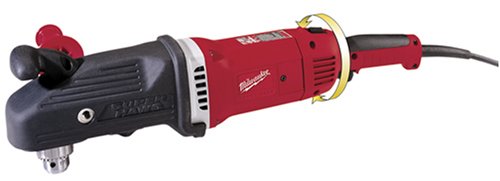
The advantages of the DeWalt over the Super Hawg are an adjustable top handle and lower weight. On the other hand, the Hawg is more powerful, has faster RPM's, and an adjustable rotating switch handle, which the DeWalt SHOULD have.
The Makita has adjustable top and switch handles, and is the lightest, but the Hawg is 30% more powerful with 50% greater RPMs, and is 4" longer, which reduces kickback effect.
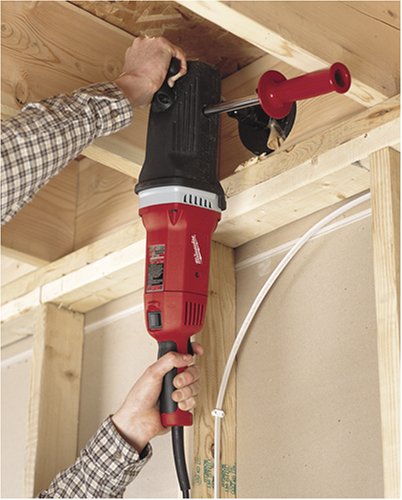
The Super Hawg's 2.5 HP motor delivers awesome performance. Check out Milwaukee's web site video of it quickly cutting through 2x lumber with self-feed bits! The tool's 22" length provides the best control over kickback. The switch handle, quickly set in one of three positions, makes a safer tool, since it's never awkward to control the switch. The only negatives are it's a bit heavy and the top handle isn't adjustable.
8/25/2007
Drill
helpful for 0 of 10 people
Tool arrived in good condition.
Purchased it for an upcoming job & have not used it.
7/12/2008
Fantastic, strong and relieable
helpful for 5 of 7 people
I am a marine contractor for 26 years and have 2 there the best electic drills we ever owned ....
5/10/2007
The Beast
helpful for 3 of 7 people
Please note: approach this drill with caution, it is not for the feint of heart. Any drill whose instruction manual spends most of its pages explaining how not to break your arm while using it is pretty hardcore.
I purchased this on sale at Amazon for a pretty great price, just in case I ever needed one. It was my first Milwaukee purchase, and has since sold me on their tools. I don't think they could have made this more heavy duty. The first thing through my mind was "what in the heck am I going to drill through with this monster???" the second thought was: "whatever I want to". I purchased Milwaukee's self-feed bit set as a companion and I'm going to plagiarize a previous review and say, sit on it and ride, 'cause it ain't stopping for nothing.
The 2 speeds and rotating handle are both handy options, well thought out and well executed. If you're looking for a drill like this, the super hawg is the one to get.
8/29/2007
Great Tool
We are using this Super Hawg for something that most operations wouldn't.
We are using a 20 pound ground auger we designed and built. We are drilling into compacted clay and rock and are wearing out carbide cutting heads. But the Super Hawg just keeps going, amazing!
1/21/2007
one incredible drill - just buy one!
I'm an electrician and have used Milwaukee power tools since 1978. I've watched the line of old hole hawgs do some amazing things in the past, as well as some frightening things (breaking wrists, knocking men off ladders, locked bits twisting the handles and ripping through 2x4's). Up until now I've avoided them like the plague. Two years ago my plumber bought one of these new super hawgs (after years of the old dangerous ones) and liked it so much he bought 3 more for his small crew. He showed it to me, I lifted it up and put it down, telling him I couldn't possibly use this tool overhead every day.
Today this same plumber brought the same (very used) drill to have me use on my totaly remodeled house (I'm playing his helper to save $). I laughed and said I'd try it, but no promises. Although only 5 pounds heavier than my usual right angle drills, it seems heavier than the advertised 15 pounds and more awkward to carry and use than my right angles, possibly because I had no idea it comes with a side handle (not offered to me today). Key for the chuck poorly designed - needs to be deeper to clear head (little things get to me, sorry). Put various sized hole saws and self-feed bits on it and away I went.
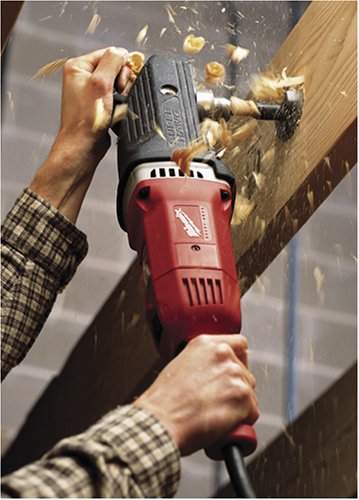
Holy crap. Dull as most of his bits were (aren't all contractors bits shot?), this damn drill was flying through everything I touched. Self-feed bits chewed so fast through 2" stock I was peppered with wood shavings. Hole saws - dull ones at that - cut through wood like styrofoam. One hole was a bit slow in cutting until I realized I had the drill in reverse, and it had been going faster through the board than would my own right angle drill in forward!
I braced myself, keeping hands and head positioned for kickbacks that never happened. Not once did I hear the safety clutch kick in or did I experience even one kickback. All day drilling and not one kickback, not even when I abused the drill grinding out angled holes that surely would have thrown me off my ladder with my other Milwaukee. I was laughing all day, saying over and over "I can't believe this tool"..."Did you see how fast I drilled that hole?" The drill's rotating speed is so fast the hole saws never "grab" on initial full contact with wood like my drill does. Your fingers never act as the bumper once the drill exits through the wood like when using my right angle. Tight stud bays were no harder to get at than with my right angle Milwaukee, too. Although heavy, just lift it like you mean it and the tool does the rest.
My plumber even used this to drill out my shower/tub valve holes. I held my breath while he simply squatted, rested the huge drill on his knees and used his body as a drill press to delicately slice through the 1/8" fiberglass as if using an Exacto knife.
My 23+ year old right angle had trouble the other day drilling 1 1/4" through 50 year old douglas fir floor joists (new bit, too), and I thought, well, time for a new right angle. My plumber offered me his hawg to use for a few days, as he has spares. No need, because guess what I'm buying online tonight? In a couple days I'll be in Super Hawg heaven, despite turning 53 with a torn rotator cuff.
9/17/2008
review of reviewer
To the gentleman who reviewed the 1680-21 and gave it 4 stars for simply arriving at the house and didn't test it;"gee that makes sense" During installation of a waste line section (4") the bi-metal bit jammed on low speed. I now understand why the manual devotes significant time to being careful. Two days and some Ben-Gay does wonders.
1/23/2009
Milwaukee Right Angle Drill
We could not be happier with our purchase. It was delivered promptly and works better than we anticipated. We are very pleased with the entire purchase process.
12/16/2008
Need brute force?
We've had this drill on the job for about 2 months now. Bought it after our Milwaukee RA drill busted while running a self-feed bit. This is one of the most powerful tools I've used. It got away from me, threw me off the roof into a pile of sand, pushed over a huge stone chimney, then spun out into the driveway and crushed a concrete truck, then knocked over a row of porta-potties with guys using them. The crane operator dropped a unit of pan decking on it to get it under control. Make sure to use the side handle!
12/24/2007
This Drill is Awsome!
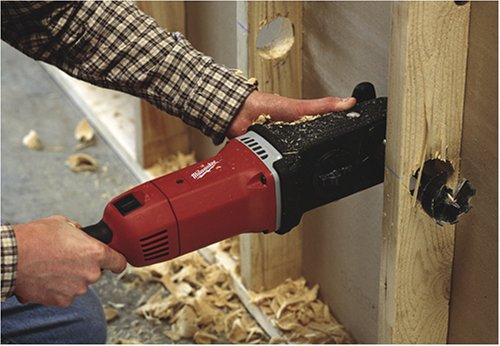
I'm an electrician and I have to drill a lot of holes when roughing in a house. This drill powers through studs and floor joist like butter. I love it and would recommended it to anyone.
8/21/2009


 Compare